











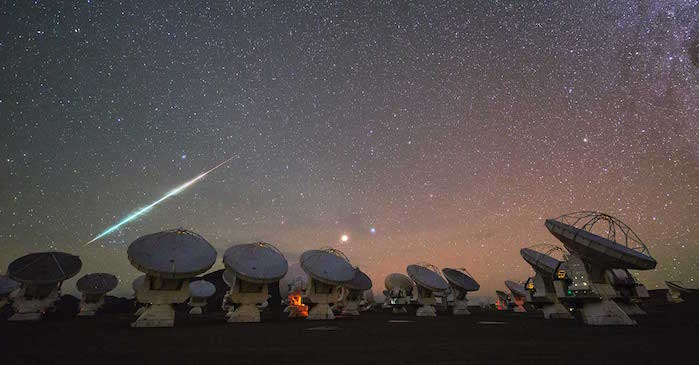
Halley’s Comet is only visible from Earth once every 75 years, but residual chunks separated from its tail hundreds of years ago generate two annual meteor showers: the Eta Aquarids in April/May and the Orionids in October.
It won’t be until 2061 that Halley’s comet gets close to Earth again, but in the meantime you can look up this week and see its remnants. Here are some things you should know about the Eta Aquarids meteor shower.
The meteors of the Eta Aquarids meteor shower are formed from the debris of Halley’s comet. It’s called Eta Aquarids because the meteors seem to emerge or radiate from near the star Eta Aquarii, the brightest star in the constellation Aquarius the Water Bearer. Although the meteors emerge from a single point, they can appear anytime and anywhere in the night sky.
This meteor shower ranks as one of the best of the year, but it does favor the Southern Hemisphere. That said, according to EarthSky.org, those at mid-northern latitudes will still be able to see some meteors and might even “be lucky enough to catch an “earthgrazer – a bright, long-lasting meteor that travels horizontally across the sky.”
Meteor showers aren’t just one-night events, but there’s typically a best time to watch. Nobody is sure EXACTLY when this will be, but according to EarthSky.org, the best time to see the Eta Aquarids this year will be the early morning hours of Thursday, May 5 and Friday, May 6. This is when it is forecasted that Earth will encounter the densest part of the debris stream, with the most meteors streaking across the sky. And, you’re in luck! The May 6 new moon will ensure even better viewing. At its peak, you should be able to see up to 30 meteors every hour.


Under One Sky 2024 was our largest and most impactful global conference to date!