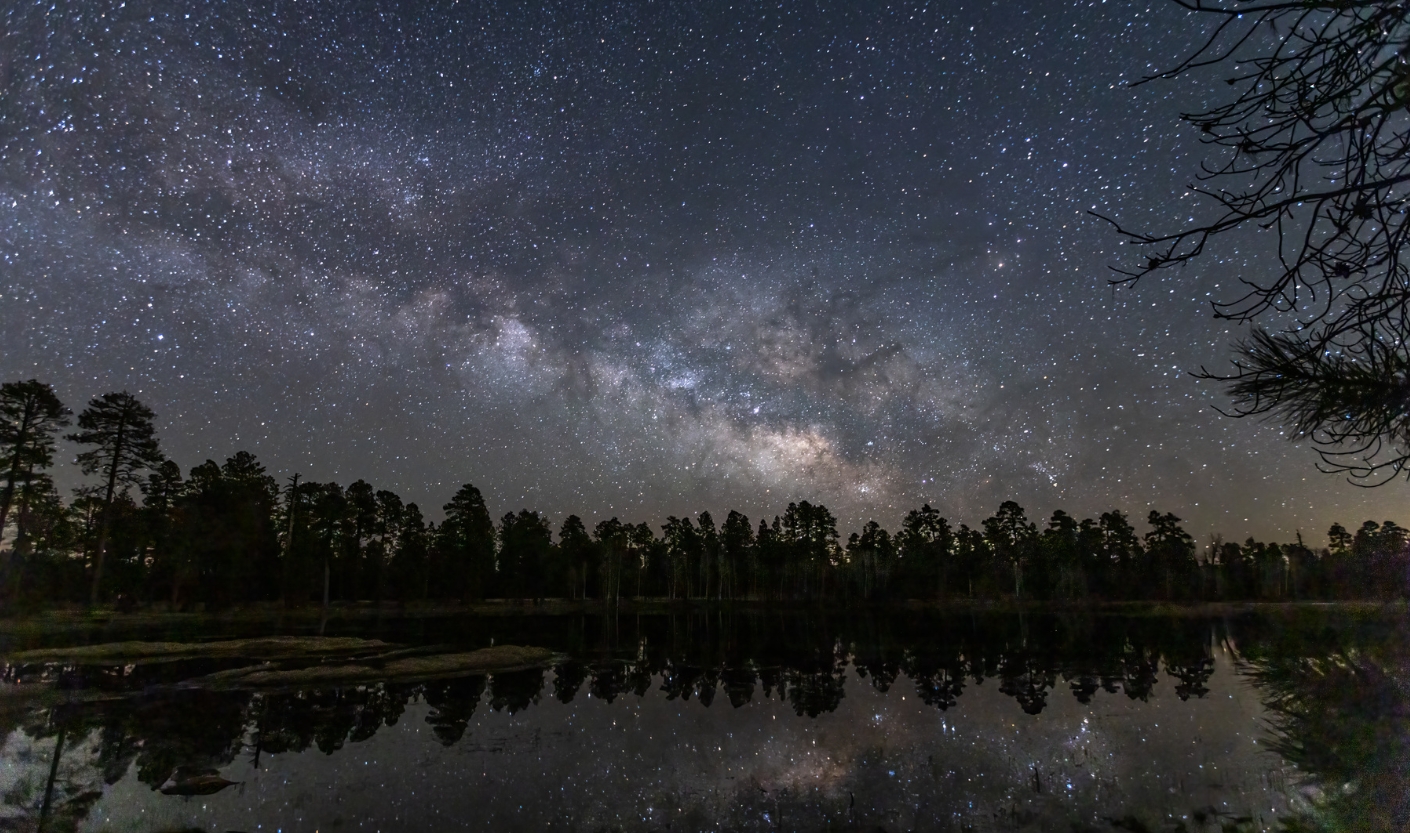











A new fulldome documentary explores darkness not as an empty space, but as a living world and an essential part of a healthy planet.
Darkness Matters is a fulldome documentary that grew from a desire to reconnect with darkness as a living space rather than a void. Through immersive cinema, it invites us to restore ecological and perceptual awareness of the night sky and the life beneath it. There is extraordinary beauty under the nocturnal vault, and much to learn about where we come from if we look up and learn to read the night sky.
In mid-May 2026, the film was invited to the Cuneo Montagna Festival in Italy. Screened in a geodesic dome that created a temporary sky for the audience, the film brought together people who had helped shape its journey: filmmaker Costanza Julia Bani; DarkSky communications associate Bettymaya Foott; biologist Dan-Eric Nilsson; alpine anthropologist and environmental guide Irene Borgna; and Federico Pellegrino, leader of DarkSky Italy.

The occasion was especially meaningful because the film was shown to communities connected to the landscapes in which it was made. It was a chance to share not only a cinematic work, but also the questions that brought its collaborators together: What do we lose when the night becomes brighter? And what becomes possible when we learn to experience darkness again?

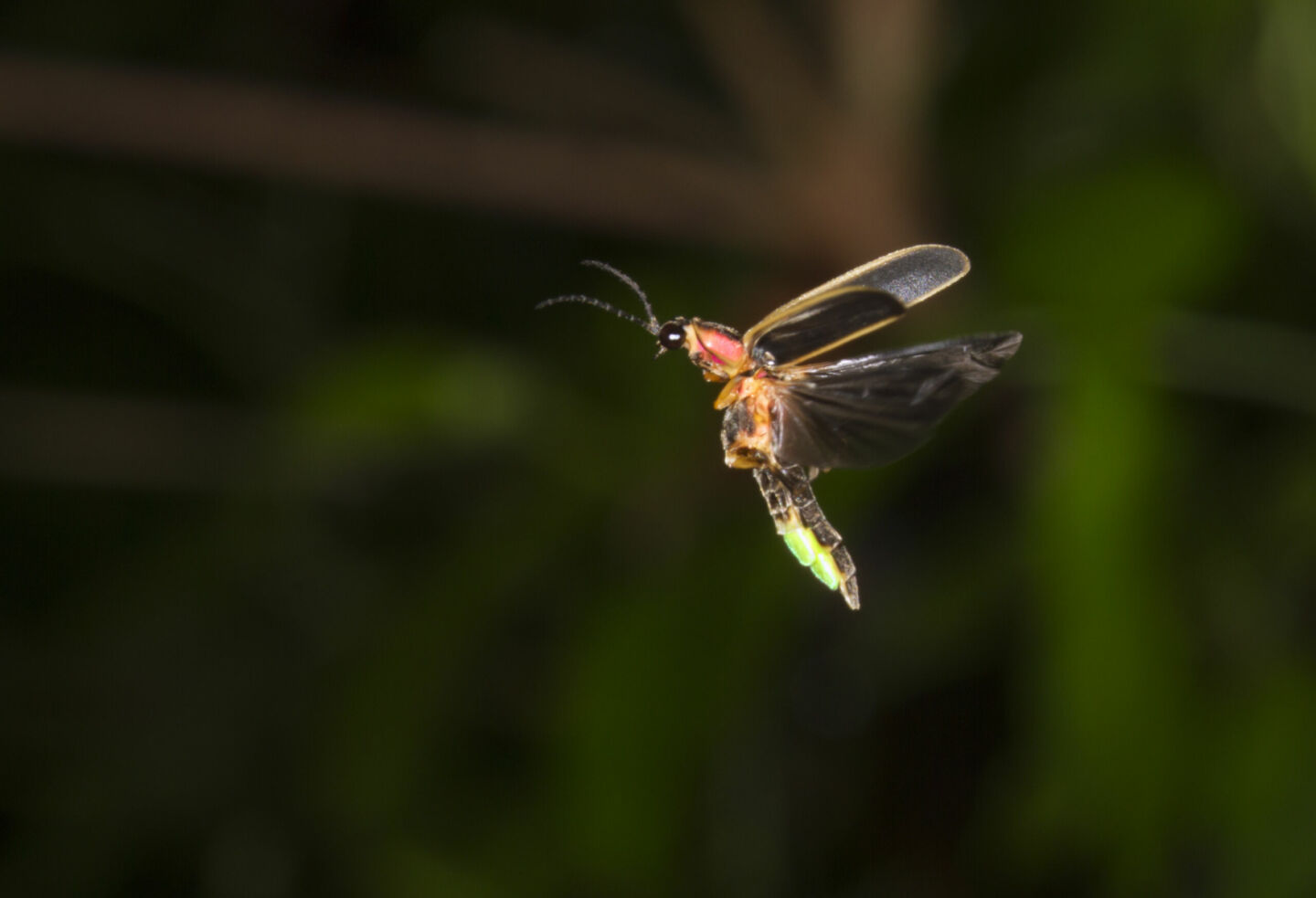
The project began with a personal memory. Growing up in Calci, Italy, filmmaker Costanza Julia Bani was mesmerized by fireflies flickering across evening fields. Years later, as she began sharing that fascination with her son, their absence became impossible to ignore. She feared that an ecosystem once so familiar might be vanishing.
Many people in the dark-sky community recognize that feeling: dramatic change witnessed in less than a generation.
From that local concern, Bani’s research expanded through conversations with experts working on light and sound pollution, and through fieldwork in the Alps. The story moved beyond one olive grove and its fireflies, becoming an artwork made through the form she knows best: documentary filmmaking.
Irene Borgna’s book Cieli Neri (Literally: Black Skies) was a crucial spark. After reading Borgna’s journey in search of Europe’s darkest places, Bani felt compelled to begin a similar exploration. Their first contact became a lasting friendship and collaboration. Borgna followed the project from its development through distribution, joined fieldwork, and has introduced the film at screenings from her own perspective, almost as a co-creator.

Although made for a dome, Darkness Matters has never been intended to remain inside one.
The film approaches darkness as a place we share with the other-than-human world: with plants and animals that thrive at night. It challenges culturally learned fears of darkness and instead suggests that the night is a place anyone can enjoy, attend to, and help protect.
The work touches on circadian rhythms, nocturnal ecosystems, and animal perception. Fireflies, a hedgehog, a wolf, an owl, and ibexes all appear in a story about how human lighting can reshape whole environments without our fully noticing. In the dome, images and field recordings surround the audience, moving from dusk to dawn and across mountain elevations to make the night a sensory experience.

The film exists because of a wide network of people trying, in different ways, to understand and protect the night.
Dan-Eric Nilsson’s research on animal vision, for example, shifts how we understand what “seeing” means. His work includes developing tools that reproduce aspects of animal vision through cameras, particularly the low-light, or scotopic, vision of non-human animals.
The parameters developed by Nilsson and by Daniel Hanely at the George Mason University in USA have been applied to the camera used for Darkness Matters to be able to reproduce the other-than-human perspective. However in post-production the data have been interpreted with a poetic license.

Borgna, who holds a PhD in alpine anthropology, has a close relationship with the Maritime Alps, where she now lives and works as an environmental guide. Through her work with Aree Protette Alpi Marittime (APAM), she also helps raise support for darker skies and the protection of local ecosystems.
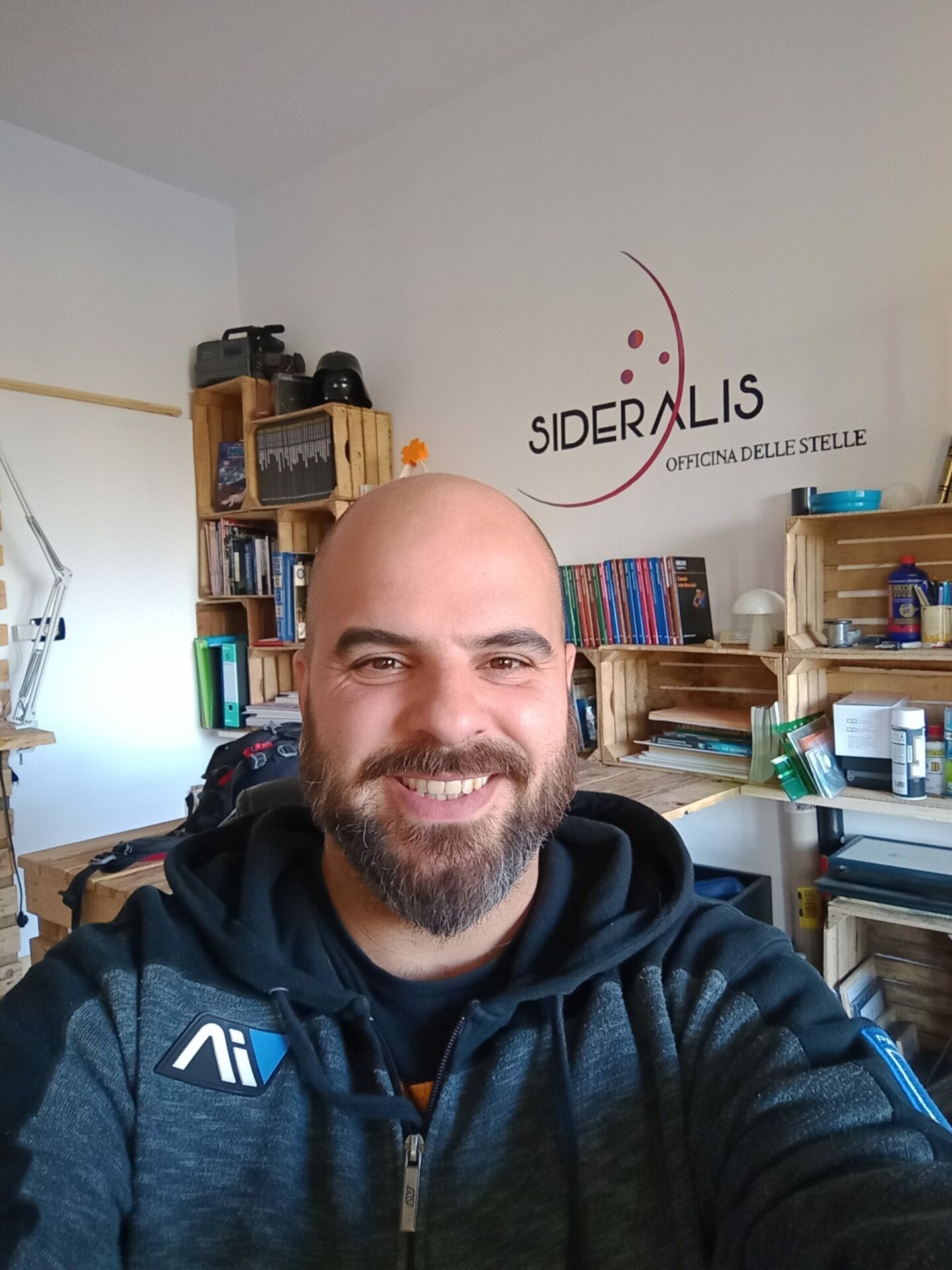
Federico Pellegrino connects advocacy to local landscapes and mountain communities through his work with CRAS Bernezzo, a wildlife recovery center, and Sideralis, DarkSky Italy’s chapter.
Bani is an artist, filmmaker, and producer whose documentary practice increasingly focuses on immersive media. She is an assistant professor in Film and Media Production at Stockholm University of the Arts, a researcher at the NAVET Centre at the Royal Institute of Technology (KTH), and course manager of the ISFF Berlin Producer Programme. In 2023, she joined the Stockholm-based production company Fellonica Film AB.

Institutions including NAVET at KTH and Stockholm University of the Arts support artistic research that creates knowledge through collaboration among the arts, sciences, and creative technologies.
DarkSky International connects this kind of work to a global effort to restore a healthier balance between light and darkness. As DarkSky International CEO Ruskin Hartley observed, “Artistic storytelling of this kind has the power to reach audiences on an emotional level, building understanding and urgency in ways that scientific data alone cannot.”
The intention behind Darkness Matters has always extended beyond viewing. The film is meant to open a pathway toward action, however small, local, or personal that action may be: noticing outdoor lighting differently; asking what is illuminated and why; and considering the ecosystems that depend on cycles we increasingly interrupt.

Its story is grounded in research on nocturnal species, fireflies, sleep physiology, and circadian rhythms, and in collaboration across scientific and interdisciplinary fields. But its invitation is simple: darkness matters, and protecting it begins with paying attention.
The film has already been presented at:
Forthcoming screenings include:
If you are interested in learning more about dark sky conservation and getting involved in your own community, look up your local chapter and check out DarkSky’s Advocate Network.

Members of the public can watch Darkness Matters online through Sandwich Vision on a range of VR headsets – You can make an account here. Rentals are $3.99 USD and purchases are $9.99 USD.
Planetaria, domes, exhibition centers, and organizations interested in presenting the film in a dome or on VR headsets can contact Costanza Julia Bani at [email protected] or world sales agent Reef Distribution at [email protected].