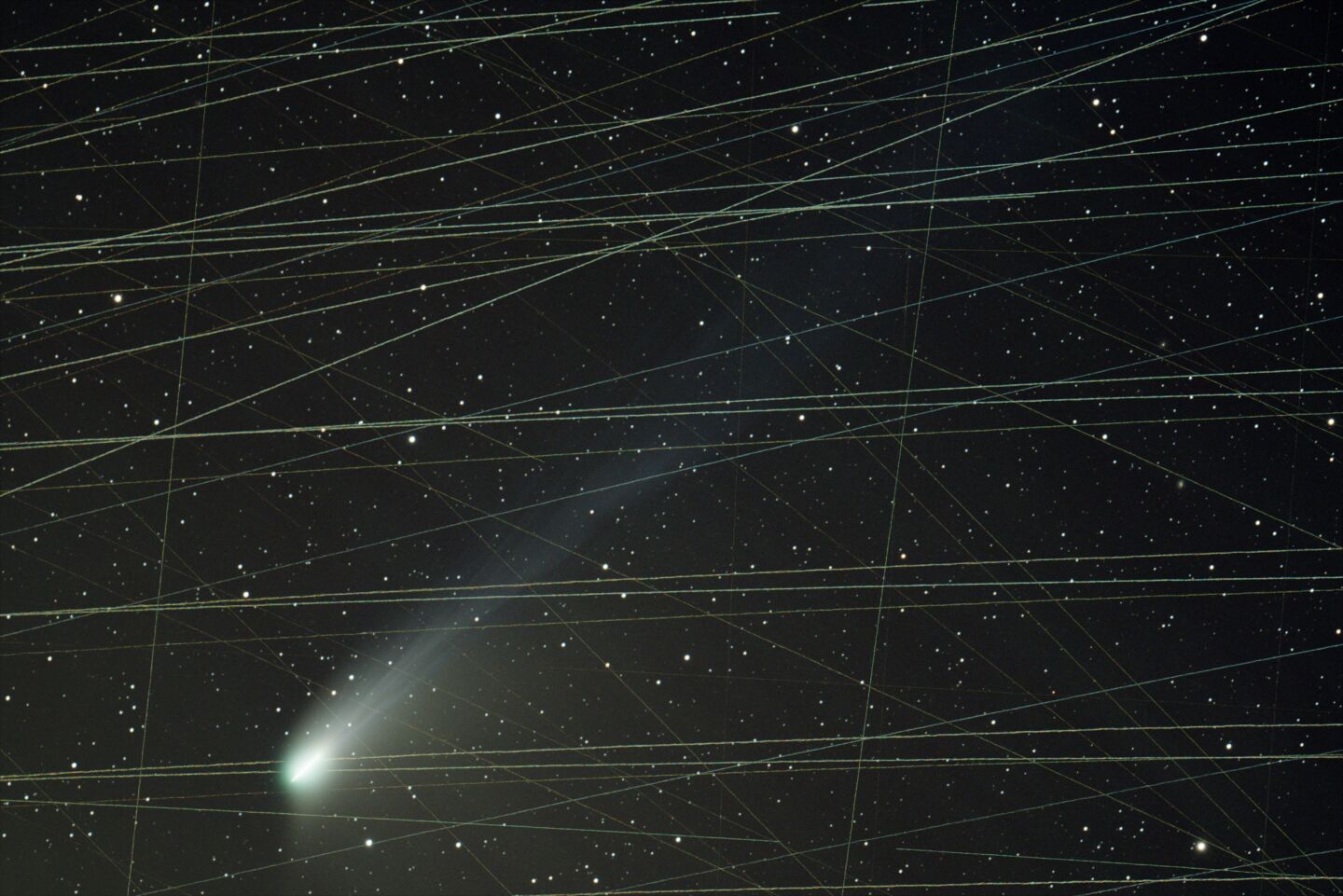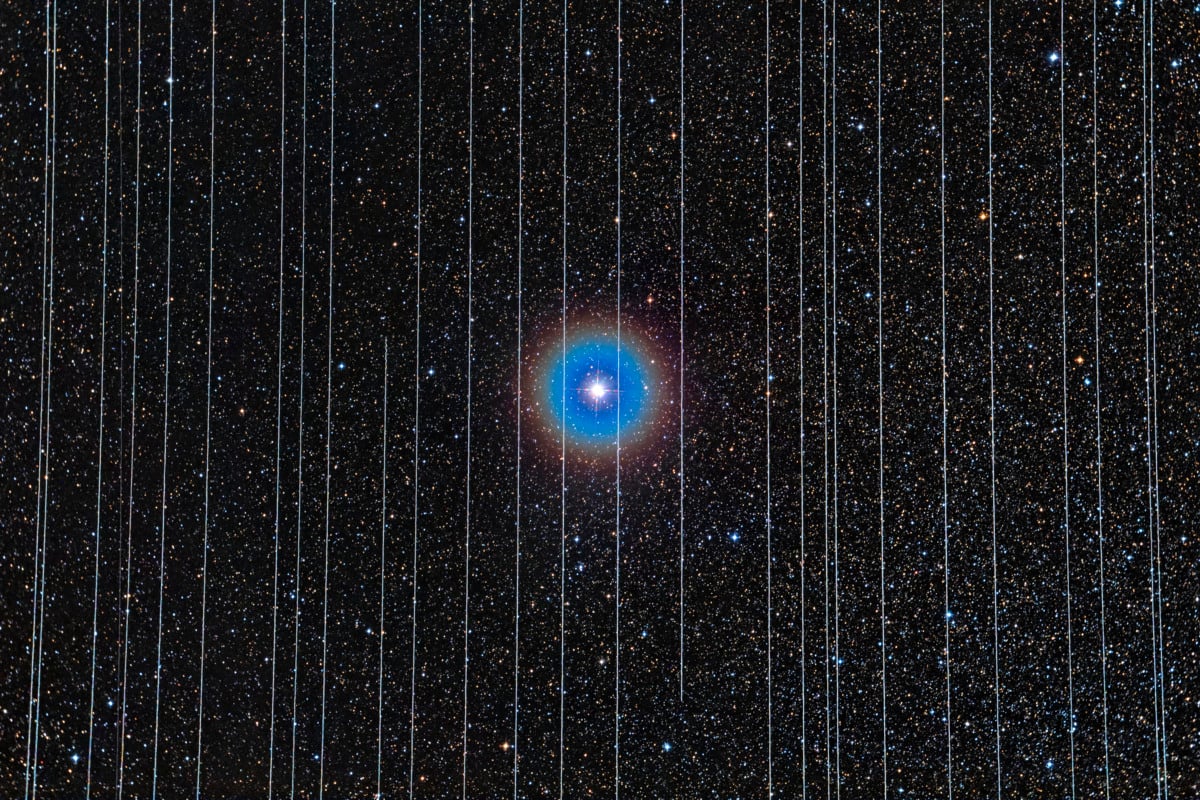










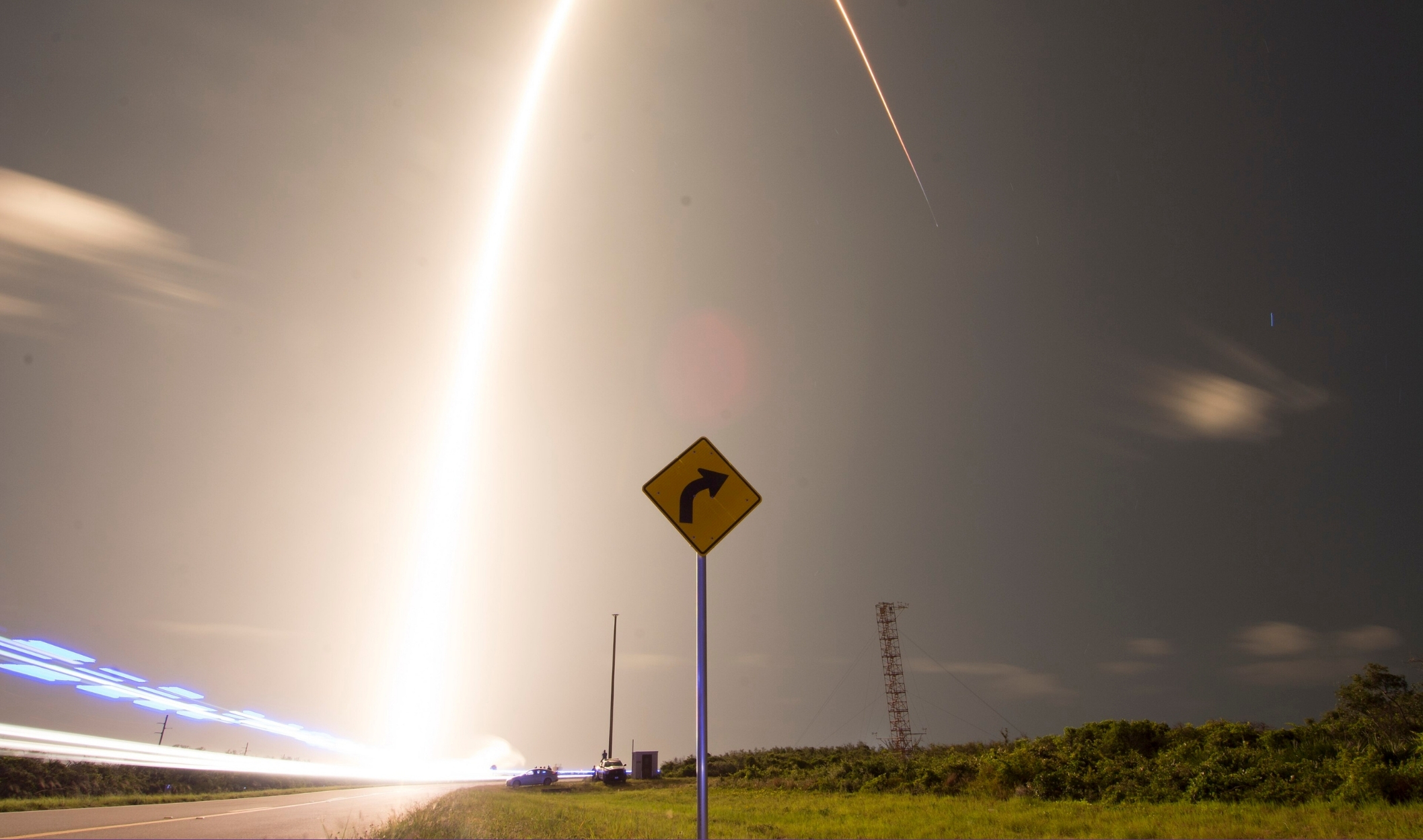
During the last new moon, I spent an hour standing in the quiet desert of Saguaro National Park. I had my camera set up, ready to capture the pristine night sky this urban night sky place is meant to protect. Knowing that there are now approximately 15,000 active satellites orbiting overhead, I braced myself for an astrophotographer’s nightmare—a sky permanently crisscrossed by artificial streaks.
Instead, I saw exactly three satellites with my naked eye. Even more surprising, in the 100-plus long-exposure frames I shot, my camera picked up a mere nine satellites in total.
Therein lies a profound, tragic irony: we have polluted our planet’s boundary layer so heavily with ground-based light that we can no longer even see the cosmic-scale footprint we are carving above it. For the vast majority of humanity, the megaconstellations rewriting the rules of our orbital ecosystem are completely invisible, masked by the ambient glow of our own cities. We are fundamentally blind to a revolution happening right above our heads.
Seven years into the era of commercial megaconstellations, we have arrived at a crossroad. Space innovation and the growth of the space economy are now high-priority, repeatedly embraced objectives globally. From the United States to the European Union, the “New Space Economy” is viewed as essential infrastructure. We can no longer treat this as an emerging trend, a billionaire playground, or a temporary experiment. Low Earth Orbit (LEO) is an established reality.
Regulators are actively preparing for LEO megaconstellations to be the permanent, dominant paradigm. The Federal Communications Commission (FCC) is currently advancing a historic, top-to-bottom overhaul of its space regulations. Under its proposed Part 100 framework, the agency plans to ditch its traditional scrutiny of individual satellite applications in favor of an automated system explicitly designed to fast-track satellite approvals like an assembly line.
The initial public comment windows for this monumental regulatory shift wrapped up in early 2026, meaning the concrete “rules of the road” are being heavily debated and finalized right now. The sheer scale of what this automated assembly line is preparing to handle should shock us out of complacency: international regulators are currently processing applications that will push the LEO population past one million satellites over the next decade.
This staggering projection is no longer driven by rural internet access; it is being fueled by the explosive, unregulated boom of artificial intelligence. Today, tech giants are facing severe terrestrial energy constraints and power grid limitations as they scramble to keep energy-hungry AI models online. To bypass these Earthbound power grids and cooling challenges, the technology sector is looking to migrate its physical computing infrastructure directly into orbit.
The warning bells are no longer coming just from frustrated dark-sky advocates. The Science7 (S7) national academies of science—representing the top scientific advisors to G7 world leaders—issued an urgent joint statement explicitly warning that standard telecom constellation plans are now “notably exceeded by recently announced projects of orbit-based data centers with AI at an alarming scale of a million-satellite constellation.”
If space-based AI computing takes off, orbital architectures will become orders of magnitude larger, entirely undoing all the progress made on darkening individual communication satellites. New research indicates that a population of one million unmitigated satellites would make satellite trails pervasive and could increase background sky brightness by up to 300%, effectively erasing the night sky. Alarmingly, the FCC’s pending automated framework continues to assess these applications in isolation, entirely ignoring the cumulative environmental devastation of allowing Big Tech to offload its AI energy crisis into our shared skies.
Seven years of data have taught us a great deal. We have learned that LEO broadband does work. It successfully bridges the digital divide for rural communities, disaster zones, and isolated environments that fiber could never reach.
Crucially, we must celebrate the success of the innovative darkening techniques that have been pioneered by industry leaders. Collaborative mitigation efforts have shown that operators can fundamentally alter spacecraft reflectivity. Because of this, ground-based astronomy has continued, and astrophotography has survived—people have found remarkably creative ways to adapt to this changing landscape.
However, we must also acknowledge that the standard brightness limits for lower orbits—and the even stricter requirements forcing satellites in higher orbits to be virtually invisible to the naked eye—have not been consistently met. To make matters more challenging, satellites themselves are physically getting larger.

Whether it makes ultimate economic sense to launch physical datacenter clusters into space, or whether the complex orbital thermal engineering required to cool them will fully work out, remains an open question. But history teaches us to be hesitant skeptics. Seven years ago, many experts questioned whether space-based consumer broadband was financially or technically viable. Today, our cell phones automatically roam onto a satellite network when we lose cell tower coverage, and commercial flights offer seamless Starlink connectivity.
If history repeats itself and these engineering hurdles are cleared, we will face an industrialized sky. The shift from launching simple telecommunication relays to hoisting heavy-duty cloud computing arrays means the progress made on darkening individual satellite chassis could be rapidly undone. The data-heavy nature of this next frontier will demand physical structures so vast they present a profound, unprecedented challenge to our shared view of the stars.
We have also learned where our regulatory fixes have run headfirst into the hard realities of orbital physics. Because of the intense atmospheric drag and harsh environment of LEO, the average operational lifespan of a commercial satellite is just five to seven years. To prevent this rapid turnover from turning space into a graveyard, the FCC enforces a rule requiring operators to deorbit their spacecraft within five years of the end of their mission.
The mechanic makes sense on paper, but it reveals a dangerous “out of sight, out of mind” illusion: because LEO hardware naturally expires so quickly, maintaining a million-satellite architecture forces us into a non-stop loop of replacing and burning up spacecraft. We are solving an orbital junk problem by intentionally vaporizing hundreds of tons of metal into our upper atmosphere every single year.
This rapid accumulation of space debris and degradation of atmospheric transparency from launch and re-entry emissions brings a severe risk of ozone depletion caused by the injection of alumina into the stratosphere. Consider the ultimate hypocrisy: the global community is locked in fierce, highly scrutinized debates over intentional geo-engineering (like solar radiation management to cool the planet). Yet, we are passively allowing private space corporations to perform unintentional geo-engineering by seeding the upper atmosphere with metallic ash, completely unmonitored. Once again, humanity is launching before we look.
While the vast majority of megaconstellation activity over the past seven years has been concentrated in the United States, we cannot assume this will be a unilateral landscape going forward. Every major geopolitical power now views LEO as vital strategic and economic real estate.
China is rapidly moving forward with its own state-backed megaconstellations, including the Guowang and G60 Horizon projects, which aim to put tens of thousands of satellites into orbit in the near future. Europe is actively developing its sovereign IRIS² secure communications constellation, and nations across the globe are asserting their right to participate in the new space economy.
Because space is inherently transboundary, US-centric solutions are no longer enough. If the rules of the road are not codified internationally, a regulatory race to the bottom will follow, where operators seek out flags of convenience in nations with the weakest environmental oversight.

We cannot simply pretend we can ban orbital commercialization, nor can we predict which technology will win the market. But while the market will decide what has legs as a service from space, our regulatory frameworks must establish the strict thresholds and standards that hold all services accountable to protect the value of natural darkness and our shared cultural heritage.
For decades, advocates and lighting professionals have rallied around the principles of ROLAN (Responsible Outdoor Light at Night) to mitigate the devastating impacts of artificial light on the ground. ROLAN teaches us that light should only be used where needed, when needed, in the amount needed, and only if it serves a clear purpose. The scale of space-based illumination is fundamentally mismatched to these lighting principles of targeted, shielded, and controlled light.
As we look to the stars, we must project these same ROLAN principles upward to draw a hard line between legitimate, targeted utility and fundamentally obtrusive exploitation:
Right now, space regulators are making a catastrophic mistake: they are assessing satellite applications in isolation. Treating every constellation as if it exists in a vacuum ignores the cumulative thresholds of our environment.
We must celebrate the foundational success of the voluntary coordination agreements pioneered between the National Science Foundation (NSF) and the FCC to protect astronomical observations. But voluntary cooperation is no longer enough to safeguard a global commons under pressure from a million planned satellites. DarkSky calls for these coordination frameworks to be codified into law, making rigorous astronomical and environmental mitigation agreements a mandatory requirement for all space licenses moving forward.
We also need to call for government and industry investment in global orbital tracking and monitoring, alongside an international air traffic control system for space. This includes dedicated R&D for monitoring skyglow, atmospheric transparency, ozone depletion, and Space Traffic Management (STM). These thresholds must evolve alongside new technology to ensure the safety and integrity of the orbital commons.
Furthermore, we must support the expansion of coordination agreements and transparency requirements for space operators to share publicly relevant data regarding launch schedules and spacecraft orbital parameters to facilitate operational, environmental, and scientific oversight. To ensure space remains accessible and visible, the high environmental and sustainability standards required of terrestrial activities must be applied equally to activities in low Earth orbit. No orbital project should be exempt from rigorous mission sustainability reviews.
We can no longer just be passive critics standing on the sidelines wishing the satellites would go away. The regulatory assembly line is being structured, and the rules are being codified right now. To protect our atmosphere, ensure civilian safety, and defend the visibility of the sky itself, we need a seat at the table to shape these guardrails. Satellite visibility should remain an unusual occurrence for the general public. Starlight must be protected for its own sake. It is time for international space law to recognize that a dark, star-filled sky is a fundamental human right, and our cumulative regulatory thresholds must reflect that truth.
If you want to explore the science, legal frameworks, and policy initiatives driving the orbital stewardship movement, we highly recommend reviewing the following source documents:
The DarkSky Legal Precedent: Review the ruling from DarkSky’s historic challenge to the FCC (Case No. 22-1337).