










By: Dawn Davies, Public Advocacy Volunteer
IDA Public Advocacy Volunteer and amateur astronomer, Dawn Davies, shares the hidden wonders of the night sky to engage our sense of wonder and inspire exploration of the night.
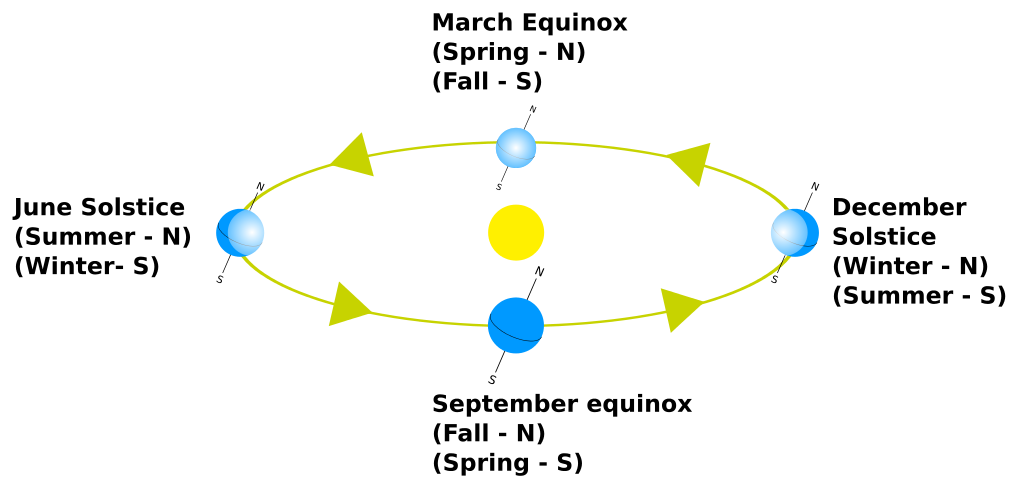
This past Tuesday, June 20, was significant no matter where you live in the world. You welcomed winter if you reside in the southern hemisphere. If you’re in the northern hemisphere, you greeted summer. Many people think that our seasons are produced by our place in orbit and relation to the sun, but the cause is more complicated.
The earth exists at an axial tilt of 23.5 degrees, but this does not mean it wobbles around a center point like a top. To visualize this, first imagine a vertical line from pole to pole, and then tilt the line 23.5 degrees. The earth circles the North Pole at this fixed angle. The amount of direct sunlight we receive, and how long we receive it, is determined by this deviation in our alignment, along with our position in our planetary orbit. The axis of the earth is pointed towards the sun this time of year, resulting in summer in the northern hemisphere. This is because we are receiving the most direct sunlight for the longest period of time—despite the fact that we are approaching our furthest point from the sun. At the same time, the southern hemisphere is angled away from the sun, thus receiving less direct sunlight, so this part of the world is experiencing winter.
What does this mean for observing the night sky? It means you need to plan accordingly for your location. As with any nighttime observing session, take note of your sunset and sunrise times, as well as your moon phase, moonset, and moonrise times. Check your forecast for temperature and humidity. Nothing spoils a night of observing more than cloud cover and heavy dew.
Lower temperatures can yield very crisp and clear skies in the colder months. During the summer months, humid air can diminish clarity and transparency. We experience rising temperatures during the summer in the southern United States, which means less bundling up, but can also spell disaster with biting insects. Problems with pests can occur anywhere, but are more frequent when warm weather is paired with nearby bodies of water. A prepared observer is a successful observer.
Previous posts have explored many objects that can be seen in the night sky with your naked eye, binoculars, or a telescope. However, additional tools can make you a better-equipped and prepared astronomer. Our basic list includes either a compass or the ability to navigate and determine your orientation. We also advise access to the outdoors, whether that is your backyard, front yard, or beyond. Read on for more tricks of the trade to maximize your observing enjoyment.
What You’ll Need and Why
Improve your observing game this summer by using some, if not all, of the tools listed above! With these tips and tools, you will be ready to take on the night sky and all the wonders our amazing universe has to offer.
Happy Solstice!