






Welcome to Advocates in Action! In this series, we interview DarkSky Advocates around the world and explore their experiences, perspectives, and passions that inspire their advocacy.
In this feature, we meet Dr. Joyful Mdhluli of the IAU Office of Astronomy for Development (OAD), whose work explores how astronomy can contribute to sustainable development through astrotourism and community opportunity. From the transformative power of awe to the potential for dark skies to support local livelihoods, Joyful invites us to think about protecting the night as an opportunity to create meaningful experiences, strengthen communities, and connect us all with something bigger than ourselves.

Firstly, I have to say that I’m super excited to be part of the Under One Sky 2026 edition! I’ll be taking part in the workshop “The Value of Awe – A Case for Astrotourism.”
I think this will be a really interesting workshop because it connects closely with two of the OAD’s flagship projects: astrotourism and astronomy for mental health. At the centre of both is this idea of awe – that feeling you get when you encounter something that makes you pause, feel small in a good way, and see yourself as part of something much bigger.
With astronomy for mental health, we are interested in how experiences with astronomy and the night sky can create opportunities for reflection, connection and wellbeing. Awe can be an important part of that experience. Looking up at a dark, star-filled sky can shift our perspective away from our immediate worries and remind us that we are part of something much larger.
With astrotourism, awe can become part of the experience that people are actually travelling for. People aren’t necessarily travelling simply to “see stars”; they are looking for an experience – something memorable, meaningful and sometimes transformative. That creates an interesting question about whether we can better understand and even measure the value that these experiences create for visitors and communities.
“Can you actually put a monetary value on awe?”
And this is where the workshop gets really interesting. Can you actually put a monetary value on awe? If an experience of the night sky contributes to someone’s wellbeing, creates a memorable tourism experience, supports local businesses or changes the way they connect with a place, how do we begin to understand and measure that value?
We’ll be unpacking some of these questions without giving too much away! I think the workshop will bring together some really interesting perspectives on astronomy, tourism, wellbeing and the value of experiences.
So, if you’re interested in the night sky, astrotourism, mental health, human connection – or you’re simply curious about whether something as intangible as awe can have tangible value – come join us!
My passion for astronomy truly sparked when I started working at the IAU Office of Astronomy for Development in 2023. Just two weeks into the role, our team visited Sutherland, where the Southern African Large Telescope (SALT) is situated. I am not sure whether that trip marked my very first view of a clear night sky or simply the first occasion I truly paused to appreciate it 😅. While I had long admired the colors of dawn and dusk, my wonder had not yet extended into the deeper dark.
It is funny looking back to my university days when a close friend pursuing astrophysics shared his experience traveling to Carnarvon to see the SKA-mid telescope. I did not quite grasp his enthusiasm back then! However, following my return from Sutherland, I reconnected with him and jokingly asked why he had never revealed just how incredible astronomy really is.
Simply put, my initial expedition to Sutherland in June 2023 opened my eyes to the beauty above, and I have kept my sight on the stars ever since. I have a short reflection of this experience published on the OAD website: https://astro4dev.org/embracing-uncertainty-a-transformative-journey-with-the-oad-office/
The Office of Astronomy for Development (OAD) is a joint project of the International Astronomical Union and the South African National Research Foundation, with support from the Department of Science, Technology and Innovation. We are hosted by the South African Astronomical Observatory in Cape Town, South Africa. At its heart, the OAD is about using astronomy – including its people, skills, knowledge and infrastructure – as a tool for development. Our vision is simple: “Astronomy for a Better World.”
One of the ways we put this vision into practice is through our flagship projects. We currently have three flagship areas, each looking at a different way astronomy can contribute to society: astrotourism, astronomy for mental health, and astronomy skills for development. The connection with dark sky conservation is particularly strong in two of these areas: astrotourism and astronomy for mental health.
With astrotourism, dark and quiet skies are essentially part of the resource we are working to protect. Astrotourism creates opportunities for people to experience the night sky, particularly in rural and underserved communities where dark skies are still relatively accessible. It can create alternative sources of income, support local businesses, and encourage communities to see their night sky as something with cultural, environmental and economic value. So, rather than looking at the night sky simply as something we observe through a telescope, we are interested in how it can become an asset for sustainable local development. That naturally creates a strong incentive to protect it from light pollution and other forms of degradation. We also see an important connection with astronomy for mental health. This flagship explores how astronomy and engagement with the night sky can create opportunities for reflection, connection and wellbeing. Many of the activities involve spending time outdoors and looking up at the night sky, and that experience is very different when you are somewhere with a truly dark sky. Protecting darkness therefore becomes part of protecting the quality of the experience itself.
For me, one of the interesting things about the OAD’s approach is that dark sky conservation isn’t treated as something separate from development. It can be connected to livelihoods, tourism, cultural heritage, environmental sustainability, education and wellbeing. When communities understand the value of their night skies and have opportunities to benefit from them, conservation can become part of a much broader conversation about sustainable development. That is really where I see the OAD’s contribution: helping to demonstrate that astronomy is not only about what happens in observatories or in space. The night sky itself is a shared resource, and protecting it can have social, cultural, environmental and economic benefits.
I don’t actively promote dark-sky conservation in South Africa directly. However, whenever I have an opportunity to speak about our flagship projects, the importance of protecting dark skies naturally comes into the conversation, particularly through our work on astrotourism and astronomy for mental health.
One of the biggest challenges I have encountered is the perception that darkness automatically means a lack of safety. I have been in a number of conversations where people associate dark or remote areas with feeling unsafe, particularly in contexts where there are concerns about crime. This highlights a communication gap: when we talk about conserving dark skies, some communities can interpret that as meaning removing or reducing lighting, rather than promoting appropriate, well-designed lighting that provides safety while also minimising unnecessary light pollution. I think there is still an important conversation to be had about what dark-sky-friendly lighting actually means.
A second challenge is the perception that becoming more dark-sky friendly is expensive. When communities or municipalities hear that existing lighting infrastructure may need to be replaced or modified, the immediate assumption can be that this will require significant investment. That can make it difficult to gain support, particularly when there are already many competing priorities for limited resources. There is therefore a need to communicate that dark-sky conservation is not simply about turning lights off, but about using the right amount of light, in the right place, at the right time, and in the right way.
And then there is the broader Global South context. Many communities are dealing with very immediate developmental challenges, including poverty, unemployment, inequality and the impacts of climate change. In that context, telling someone that they need to protect their night sky can understandably be difficult to prioritise. This is where I think astrotourism can play a really important role. If we can demonstrate that protecting dark skies can also support local economic development, create tourism opportunities, support small businesses and generate livelihoods in rural and underserved communities, then the conversation changes. We are no longer asking communities to protect the night sky simply for astronomy; we are showing how it can become part of a broader sustainable development opportunity.
South Africa provides a really interesting example of how these ideas can come together. Following the launch of the South African Astrotourism Strategy and Implementation Plan 2024-2034, the Departments of Tourism and Science, Technology and Innovation have been working with DarkSky International to explore opportunities for community certification. The intention is to begin in the province that is home to both the Southern African Large Telescope (SALT) and the SKA-Mid telescope.
For me, this is an important example of how dark-sky conservation can move beyond being an environmental or astronomical issue and become part of a much bigger conversation around tourism, community development, livelihoods, heritage and sustainable development.
I wouldn’t describe myself as a direct advocate for dark-sky conservation, so I think my greatest success has been helping to create connections between dark skies and broader development opportunities, particularly through our work on astrotourism.
Through the OAD, I have had the opportunity to contribute to conversations that position the night sky not only as something important for astronomy, but also as a resource that can support local economic development, tourism, cultural heritage and environmental sustainability. I think that shift in perspective is particularly important in the Global South, where conservation messages need to be connected to the realities and priorities of local communities.
One opportunity that stands out for me was being invited to speak at a workshop hosted by the United Nations Office for Outer Space Affairs (UNOOSA) and the Square Kilometre Array Observatory (SKAO) on protecting dark and quiet skies for science, society and development in December 2025. It was a valuable opportunity to bring an astronomy-for-development perspective into an international conversation about dark and quiet skies, and to highlight how these discussions can extend beyond astronomy and connect with development, communities and sustainable tourism.
Our work on the astrotourism flagship has been particularly rewarding in this regard. We are interested in approaches that go beyond simply bringing tourists to observatories or dark-sky sites, and instead explore how communities can develop their own astronomy and night-sky experiences. If done well, this can create an economic incentive to value and protect dark skies while also creating opportunities for local people.
I have also been encouraged by the growing recognition in South Africa of the potential to connect astrotourism and dark-sky conservation at a national and community level. The South African Astrotourism Strategy and Implementation Plan 2024-2034, and the subsequent conversations around community certification with DarkSky International, are examples of how these different sectors can begin working together. And being able to be part of the engagements and workshops has been exciting.
So, rather than saying my greatest success has been directly advancing dark-sky conservation, I would say it has been helping to broaden the conversation about why the night sky matters and how protecting it can contribute to development. For me, that is where astronomy for development and dark-sky conservation can meet in a meaningful way.
I’m always terrible at giving people advice, but if there’s one thing I would say, it’s don’t feel like you have to do it alone.
The DarkSky community is full of incredibly passionate and knowledgeable people. If you’re starting out as an advocate, there are thousands of people who have been on this journey and are willing to share their experiences, offer support and help you along the way.
So, find your community, ask questions, learn from others and don’t be afraid to reach out. You don’t have to have all the answers when you start – you can learn as you go.
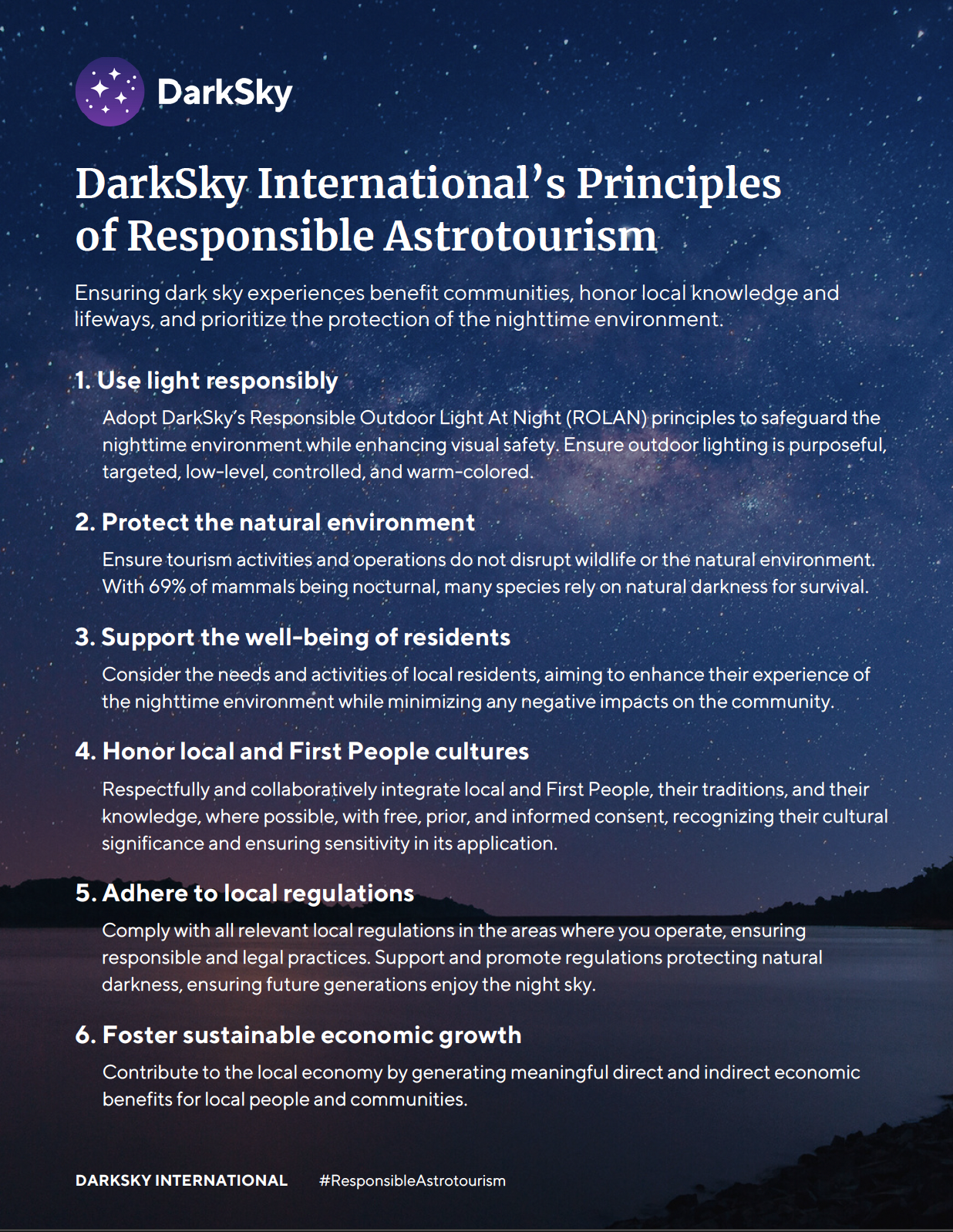
I’m going to be a little biased and say DarkSky International’s “Principles of Responsible Astrotourism.” It’s a favourite of mine because it aligns very closely with the work we do through the OAD’s astrotourism flagship, and the resource is also endorsed by the OAD.
What I particularly like about the DarkSky resources more broadly is that they are simple, practical and straightforward. You don’t need to be a dark-sky expert to understand the key messages or see how they can be applied, and I think that makes them very effective.
The OAD has also developed a number of resources around astrotourism for different audiences – including individuals, organizations, existing tourism operators, observatories and communities around observatories. In developing these resources, we refer to existing DarkSky guidance, particularly resources such as the “Five Principles for Responsible Outdoor Lighting.” This helps us connect the development and tourism side of the conversation with practical approaches to protecting the night sky.
For me, that combination is particularly useful: resources that are easy to understand, but also provide practical guidance that people can actually use.
The peace that comes with the night. Everything seems to slow down, and it gives you a chance to pause, be present and simply enjoy the moment. I also love how the night sky gives you a different perspective – it reminds you that there is a much bigger world beyond our everyday lives.
A big thanks to Dr. Joyful for chatting with us! Don’t miss her presentation at Under One Sky this November 2026! Check out conference.darksky.org to learn more and register.
Check out Joyful’s recommended Astrotourism Resources (Available in English, Spanish and Persian) – Links below are to the English resources:
If you’d like to connect with Joyful and the OAD, you can reach out via the following links: